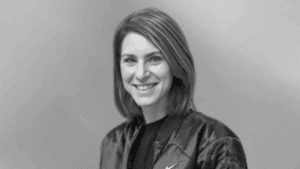
Spargle meets Elisabeth Hovius
Consultant EMEA Brand Marketing Strategy @ Nike
What is your role?
My role is Consultant EMEA Brand Marketing Strategy and I’m responsible for three teams that guide and support marketing processes across the organization. I often describe my team as an “octopus,” because we’re connected to all marketing teams and make sure those teams can work as efficiently and effectively as possible. That means we help define processes, but also select and implement the right tools for collaboration. We support teams in managing workflows, deadlines, and overall planning. At a company like Nike, there’s a very extensive marketing calendar with many campaigns happening simultaneously. So a big part of our role is making sure that everything happens at the right time and in the right way.
“I often describe my team as an “octopus,” because we’re connected to all marketing teams and make sure those teams can work as efficiently and effectively as possible.”
What does that entail?
To clarify, my role is mainly about internal marketing support. We don’t create campaigns ourselves, but we support the teams that do. We make sure they have the structure, clarity, and tools they need to perform at their best. That requires a lot of coordination and alignment, but also flexibility, because every team has slightly different needs. So it’s a very dynamic role, and no day is ever the same.
What are some challenges you face, and how do you overcome them?
One of the biggest challenges right now is the amount of change Nike has gone through. Over the past few years, teams have evolved, roles have shifted, and structures have changed, bringing fresh starts and lots of new opportunities. However, change is not always easy for everyone. Adapting to new responsibilities or new colleagues takes time, and it’s natural that people need a moment to find their footing again. That’s where I put my energy. I genuinely enjoy building teams, and I have a lot of experience with it. I spend a lot of time listening, understanding how people are impacted, what they need, and how I can support them. It’s about creating space for conversations, doing team-building sessions, and setting clear goals together.
At the same time, the market is highly competitive. Many new brands are entering the space and that puts pressure on performance. Luckily the Nike mentality is very strong. So there’s a huge shared effort to perform. I try to contribute to that by helping my teams stay as aligned and focused as possible on all that truly matters.
How do you maintain motivation when everyone is still finding their place?
For me, it always starts with a shared vision. You can put one on paper, but if people don’t understand it, feel connected to it, or truly believe in it, it doesn’t mean much. I spend a lot of time asking questions. I try to visualise how people see their role, their team, and how they all connect to the bigger picture. Listening is really at the core of this process. Me, listening to the team, but also team members listening to each other. Often, people don’t fully know what their colleagues are working on, what challenges they face, or what their responsibilities are. If that understanding is missing, it’s very hard to function as a true team. From that, if the goals and the tracks are clear, intrinsic motivation follows. Then people have some form of progress to be proud of.
“Listening is really at the core of this process. Me, listening to the team, but also team members listening to each other.”
What did you study?
I did a Bachelors’ in European Studies, which focuses on politics, economics and history within the European Union. I’ve always been drawn to international environments. I love working with people from different cultures and backgrounds and finding synergies between them. The European Union felt like the perfect combination of those elements: international collaboration, complex structures, and the opportunity to work on projects with real history and influence.
There’s a quote my husband really likes: “Those who do not remember the past are condemned to repeat it.” It sounds a bit dramatic, but I do think there’s a lot of truth in it. So much of what we experience today has already happened in some form, and understanding that helps you make better decisions.
How did you decide to go into this direction?
During my studies, I learned not just how a huge organisation like the European Union was built, but also what didn’t work so well. That perspective of looking at both success and failure is something I still carry with me in my work today. However, after spending time in places like Brussels and The Hague, I realized it wasn’t the right environment for me. The pace of decision-making is quite slow, and I found that challenging. I like to move faster, to make decisions and see results more directly.
That’s when I decided to shift direction and pursue a Master’s in International Business. It allowed me to stay in an international context, but in a more dynamic and fast-paced environment. I started my career as a marketing trainee at L’Oréal, and from there, I grew into different roles in marketing, digital and commercial strategies and eventually into leadership.
“I find a slow decision-making pace challenging. I like to move faster, to make decisions and see results more directly.”
What trends do you foresee for this year?
It’s becoming increasingly important to have a very clear and strong personal profile because of rising competition in the freelance space. You need to be quite specific about what you stand for and what you bring to the table. In addition to that, the way people are selected is also changing. In many companies, if your profile or CV doesn’t match certain keywords, you might not even get through the first selection, sometimes that’s already done by AI systems. It’s not just about what you can do anymore, but also about how you communicate it.
At the same time, I do think there’s still a strong need for the human element. Even though systems and AI play a role, personal connections and reputation still matter a lot. So it’s really about finding the balance between being clearly visible on paper and building good relationships in real life.
Who inspires you, and why?
My father has been a huge source of inspiration for me. He treats everyone with respect, regardless of their background or position, and he’s genuinely interested in people. When I was younger, he never put limitations on what I could do. Instead, he encouraged me to focus on my strengths and think about what I wanted to achieve. Later in life, he had an accident and was in a coma for several months. Luckily survived, and what I find incredibly inspiring is how he dealt with that situation. He chose acceptance and focused on what he still had and could still do. He really lives by appreciating life, the “carpe diem” motto. That mindset has made me more aware, more patient, and more appreciative of both people and situations.
“Our differences make collaboration interesting and effective. If everyone in a team were the same, it simply wouldn’t work.”
Is there a quote you live by?
Yes, my favorite quote is by Oscar Wilde: “Be yourself; everyone else is already taken.”
It might sound simple, but I think it’s very powerful. For a long time, especially when I was younger, I could feel insecure about who I was or how I compared to others. I think that’s something many people experience. Over time, I’ve learned that being yourself is actually your biggest strength. We all have similarities, and that helps us connect. But it’s our differences that make collaboration interesting and effective. Imagine if everyone in a team were the same! It simply wouldn’t work. I try to create an environment where people feel comfortable being themselves, because that’s when they perform at their best.
What are your favorite books, podcasts, or documentaries?
I have quite a few, but if I had to choose, I would say I really enjoy cookbooks, especially those by Yotam Ottolenghi. I love cooking, and his recipes are full of flavor but still accessible. What I appreciate is that they work for different dietary preferences, and they always feel a bit special, even if they’re simple to prepare.
In terms of professional inspiration, I follow Simon Sinek quite a lot. His work on purpose, leadership, and team building has been very influential for me. A lot of what I apply in my role, especially around creating purpose and building strong teams, connects to his ideas. What I also find interesting about him is that, even though he’s a well-known speaker, he describes himself as quite introverted. That contrast is fascinating, and it shows that you don’t have to fit a certain mold to be effective in leadership.
